Four diagrams and a working tool. Between them they answer the questions a clinical team, an information governance lead and a commissioner each ask first — and they answer them differently, which is why there are four.
Twelve steps from a person noticing a change to the data that proves the model works or stops it. The lanes matter more than the boxes: everything in the top two lanes is gathering, routing and chasing. The amber steps in the bottom lane are clinician-only and stay that way.
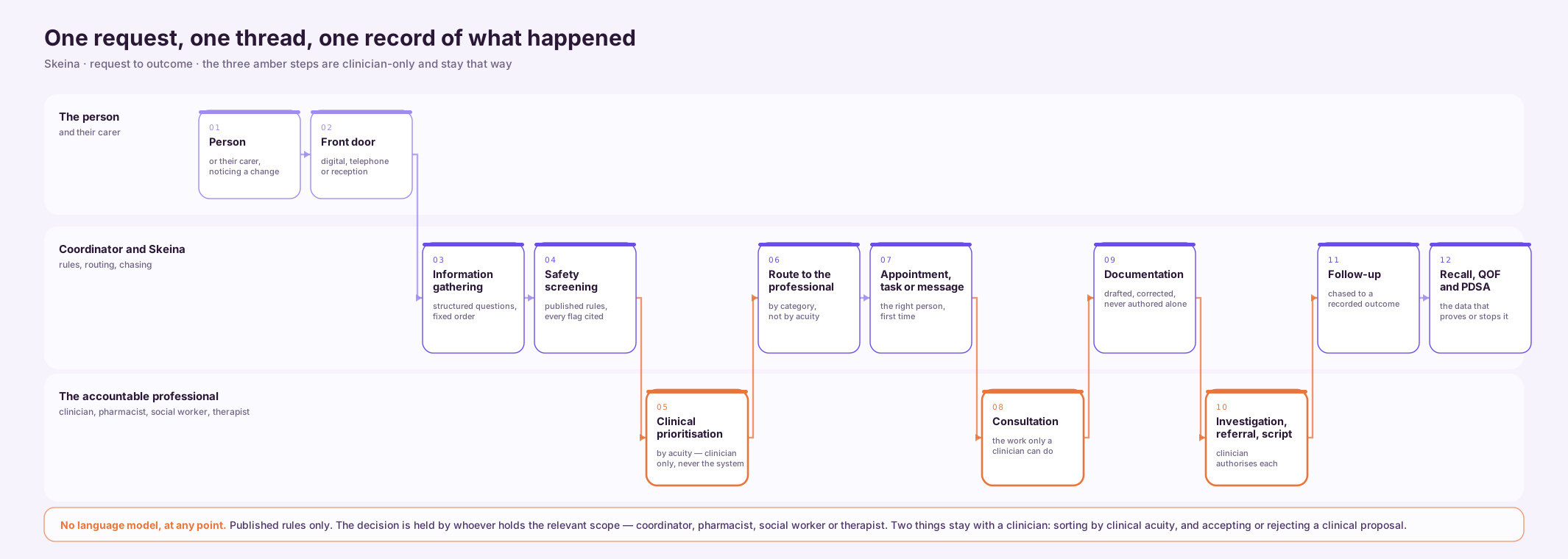
Step 05, clinical prioritisation, sits in the professional's lane rather than the system's. Clinical acuity assessment and acceptance of clinical proposals remain with appropriately qualified professionals; Skeina does not autonomously make or execute clinical decisions. Whether any Skeina function qualifies as software as a medical device will nevertheless be determined from its intended purpose and functionality, with formal MHRA advice sought before deployment. We have deliberately designed Skeina to minimise autonomous clinical decision-making and maximise inspectability — that is a safety architecture, not a claimed regulatory exemption.
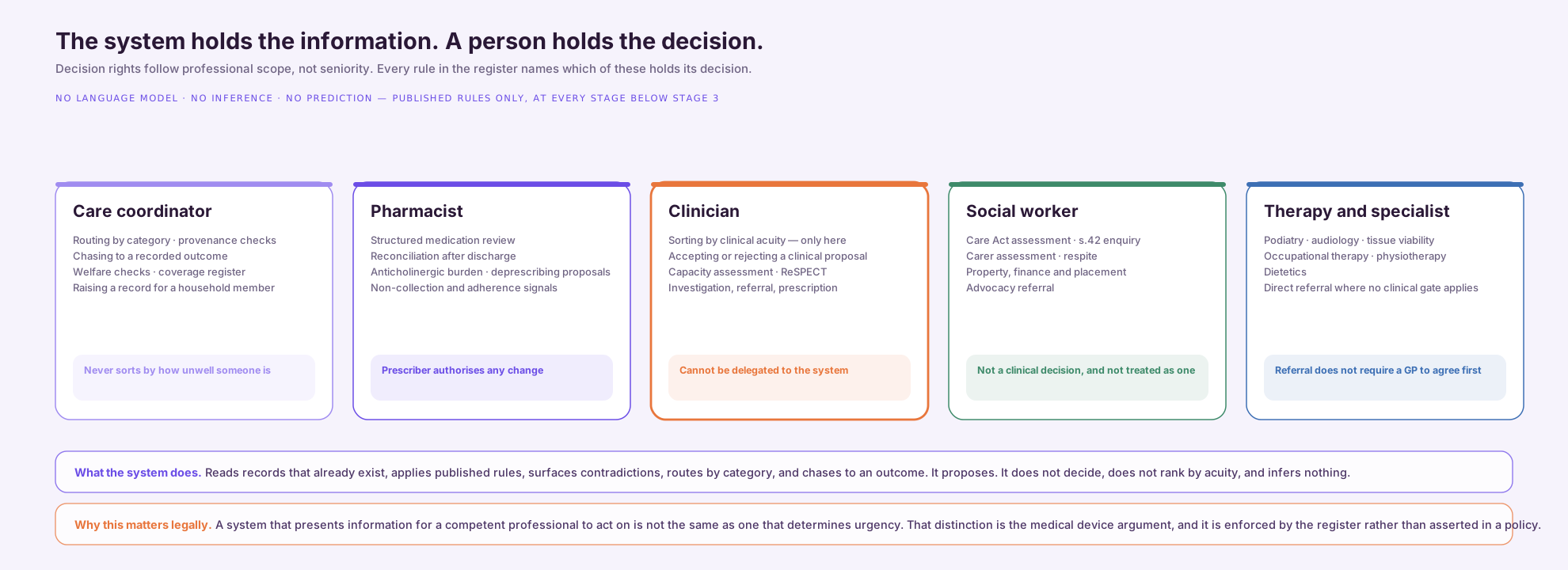
And one decision right sits above the professional lanes: the person. The person decides whether they want non-mandatory help, what outcome matters, whether a proposed community referral is acceptable, and whether the outcome counts as success. Declining help is a recorded, respected outcome — the platform must never become an elegant system in which professionals remain the only decision-makers.
Decision rights follow professional scope, not seniority. A pharmacist decides a medicines question within their competence. A social worker decides a Care Act matter. A coordinator decides routing. Every rule in the register names which of them holds its decision.
Sorting by clinical acuity, and accepting or rejecting a clinical proposal. Both stay with a clinician. Not because other professions are less capable — because these are the two points where clinical accountability sits, and no colleague would want them arriving by default.
Who is accountable when a coordinator routes something that turns out to be clinical? The answer is built into the escalation list rather than left to judgement: over-escalating carries no penalty and must never be discouraged, formally or informally. A falling escalation rate is investigated rather than celebrated, because it usually means someone has learned to predict what the clinician will say.
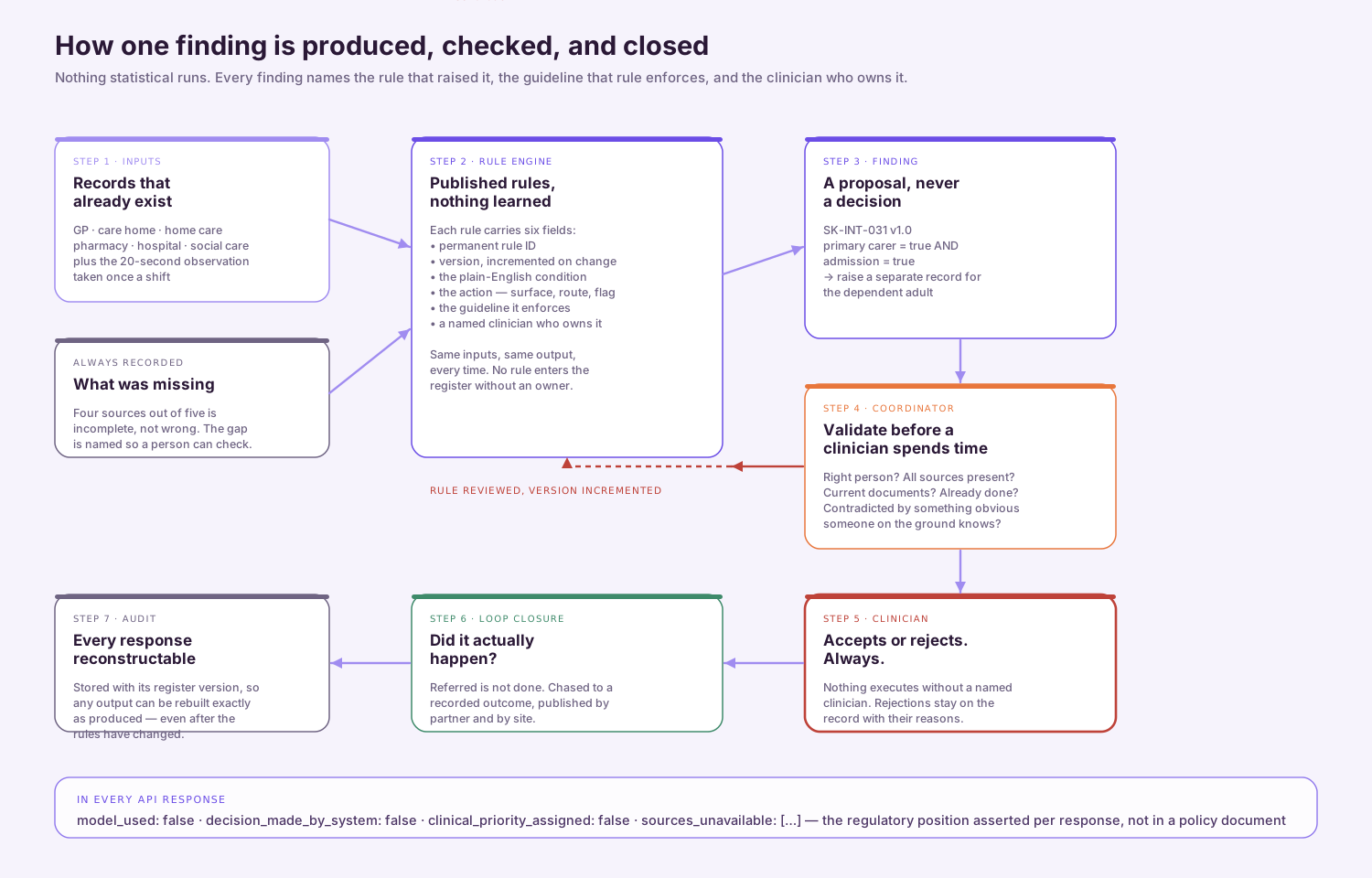
This is the information governance diagram. It follows a single finding from the records that already exist, through the rule that raised it, past the coordinator who validates it and the clinician who accepts or rejects it, to the outcome and the audit trail.
Follow the red line. When a coordinator sends a finding back, the reason is recorded and the rule is reviewed — and if it changes, the version increments and the old one is retained. Send-backs are the primary quality signal in the early stages. A send-back rate falling to zero is a warning, not a success.
Mandatory fields on every rule, including a named clinician who owns it
Findings that execute without a person accepting them
Rules currently in the register, all readable in one sitting
Version token stored with every response, so any output can be rebuilt exactly
model_used: false · language_model_used: false · logic: "deterministic_conditional_rules" · statistical_inference: false · decision_made_by_system: false · clinical_priority_assigned: false · sources_unavailable: […]
The regulatory position stated per response, machine-readable, rather than described in a policy document. Worth writing into any integration contract.
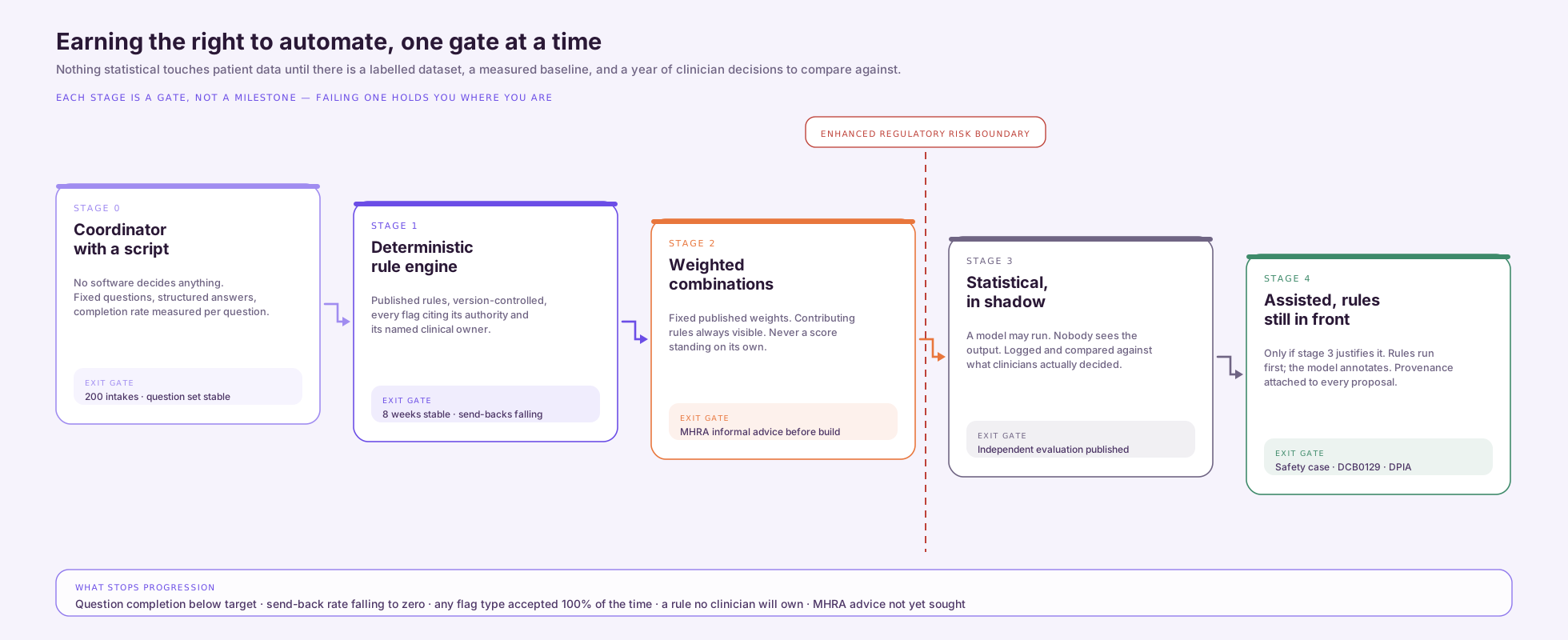
The question a commissioner actually wants answered is when the AI arrives. The answer is: not until four gates have been passed, and here is exactly what stops it at each one. Nothing statistical touches patient data until there is a labelled dataset, a measured baseline, and a year of clinician decisions to compare against.
The dashed red line after stage 2 marks an enhanced regulatory risk boundary, not the start of regulation. Formal medical-device qualification applies throughout development and is reassessed whenever intended purpose or functionality changes; a deterministic rule can still perform a medical purpose. Stage 3 introduces additional classification and validation considerations — it is not the first point at which medical-device regulation may apply. Informal MHRA advice belongs early, and before that boundary in any event.
The intake tool is a working rule engine, not a picture of one. Answer the questions and the rules evaluate as you go, each finding naming the rule that raised it, the guideline that rule enforces, the clinician who owns it, and the professional who holds the decision.
Fifty dummy scenarios are loaded — care homes, nursing homes, discharge and end of life, falls, podiatry and diabetes, safeguarding, community concerns, social prescribing, carers and households, acute presentations and advance care planning. All fictional. Load one and watch what fires.
Open the intake toolNothing persists — close the tab and it is gone. Nothing is transmitted. It reads no records; every input is typed by hand. This browser demonstration is not deployed for clinical care — but clinical safety engineering begins during development, not at go-live. Before any live use, Skeina will complete the applicable DCB0129 manufacturer clinical-risk-management activities, and each deploying organisation will undertake DCB0160; DTAC, DSPT and a DPIA are additionally required for deployment. NHS England is reviewing DCB0129/0160 during 2026, and Skeina's safety case will track the revised standards.